

Hey there! As a supplier of Flexographic Machines, I've had my fair share of experiences and knowledge about the ins and outs of using these machines. Today, I want to chat about one particular topic that's both challenging and interesting: the challenges of printing on metallic materials with a flexographic machine.
Understanding Flexographic Printing
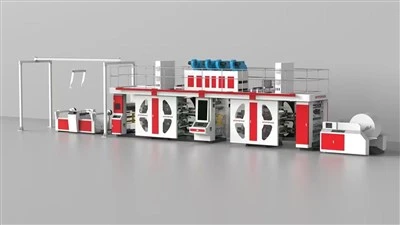
First things first, let's briefly go over what flexographic printing is. Flexography is a type of relief printing process that uses a flexible relief plate made of rubber or photopolymer. It's a popular choice in the printing industry because of its high-speed capabilities and the ability to print on a wide range of substrates. Our Flexographic Printing Machine is designed to offer efficient and high - quality printing solutions for various industries.
The Appeal of Printing on Metallic Materials
Metallic materials, such as aluminum foil, metallized films, and metalized papers, are quite desirable in the packaging and printing world. They give products an upscale and eye - catching look. For example, in the food industry, metallic packaging not only protects the food from light and moisture but also makes the product stand out on the shelves. The shiny surface of metallic materials can create a luxurious feel, which is great for premium products like chocolates or high - end cosmetics.
Challenge 1: Surface Tension and Adhesion
One of the biggest hurdles when printing on metallic materials with a flexographic machine is dealing with surface tension and adhesion. Metallic surfaces have a very smooth and non - porous nature. This means that the ink has a hard time adhering to the surface. The surface tension of the metallic material often causes the ink to bead up instead of spreading evenly.
To overcome this, we need to pretreat the metallic surface. Corona treatment is a common method. It uses a high - voltage electrical discharge to modify the surface of the metal, increasing its surface energy and making it more receptive to ink. However, getting the right level of corona treatment can be tricky. If it's too low, the ink won't adhere properly. If it's too high, it can damage the metallic surface. Our High Speed Flexo Printer can be adjusted to work in tandem with the corona treatment process, but it still requires careful calibration.
Challenge 2: Ink Compatibility
Ink compatibility is another major challenge. Metallic materials require special inks that are formulated to adhere to their surfaces. These inks need to have good chemical resistance, as metallic packaging may come into contact with various substances during storage and transportation.
The inks also need to be able to withstand the high - speed operation of the flexographic machine. If the ink dries too quickly, it can clog the anilox roller and the print plate, leading to poor print quality. On the other hand, if it dries too slowly, it can cause smudging and misregistration. We've developed a range of inks that are specifically designed for printing on metallic materials with our Stack Flexo Press, but finding the perfect match for each type of metallic substrate is still an ongoing process.
Challenge 3: Print Quality and Resolution
Achieving high - quality and high - resolution prints on metallic materials is no easy feat. The smooth surface of the metal can cause issues like dot gain and ink spread. Dot gain occurs when the ink dots on the print are larger than they are on the printing plate. This can result in a loss of sharpness and detail in the print.
To counteract dot gain, we need to carefully control the ink transfer process. The anilox roller plays a crucial role here. It meters the ink and transfers it to the print plate. Selecting the right anilox roller with the appropriate line screen and cell volume is essential for achieving good print quality. Our Plastic Film Flexo Printing Machine has advanced anilox roller technology, but we still need to constantly fine - tune it for metallic printing.
Challenge 4: Static Electricity
Static electricity is a nuisance when it comes to printing on metallic materials. The friction between the metallic substrate and the various components of the flexographic machine can generate static charges. These charges can attract dust and other contaminants, which can get onto the print surface and ruin the print quality.
Static can also cause the metallic substrate to stick together, making it difficult to feed the material through the machine smoothly. To combat static electricity, we use static eliminators in our Inline Flexo Printing Machine. These devices neutralize the static charges, but they need to be properly placed and adjusted to be effective.
Challenge 5: Cost and Efficiency
Printing on metallic materials can be more expensive than printing on other substrates. The special inks required for metallic printing are often more costly. Additionally, the pretreatment process like corona treatment adds to the production cost.
In terms of efficiency, the challenges we've discussed above can slow down the printing process. For example, if the ink isn't adhering properly, we may need to stop the machine and make adjustments. This can lead to downtime and reduced productivity. As a supplier, we're constantly looking for ways to optimize the printing process on metallic materials to reduce costs and improve efficiency.
Solutions and Future Outlook
Despite these challenges, there are solutions. We're investing in research and development to create better inks, more efficient pretreatment methods, and advanced machine technologies. For example, we're working on developing self - leveling inks that can better adhere to metallic surfaces without the need for excessive pretreatment.


In the future, I believe that the technology for printing on metallic materials with flexographic machines will continue to improve. We'll be able to achieve even higher print quality, greater efficiency, and lower costs.
Let's Connect
If you're in the market for a flexographic machine and are interested in printing on metallic materials, we'd love to have a chat. We can provide you with more detailed information about our machines and how they can overcome these challenges. Whether you're a small business just starting out or a large - scale manufacturer, we're here to help you find the best printing solution for your needs. Get in touch with us to start the conversation and explore the possibilities of using our flexographic machines for your metallic printing projects.
References
- Smith, J. (2020). Advances in Flexographic Printing Technology. Printing Industry Journal.
- Johnson, M. (2019). Metallic Packaging Printing: Challenges and Solutions. Packaging World Magazine.