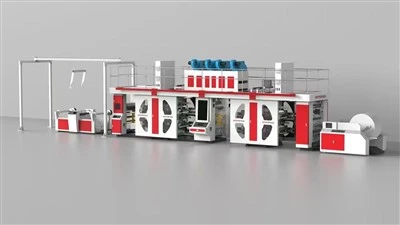


The movement mechanism of the print head in a non woven fabric printer plays a crucial role in determining the overall printing speed. As a leading supplier of Non Woven Fabric Printers, we have delved deep into understanding how different print head movement mechanisms impact printing speed. In this blog, we will explore the various aspects of print head movement and their effects on the efficiency of non woven fabric printing.
1. Types of Print Head Movement Mechanisms
Linear Movement
Linear movement is one of the most common types of print head movement mechanisms. In this setup, the print head moves in a straight line across the non woven fabric. This movement is typically achieved through a set of linear guides and motors. The simplicity of linear movement allows for relatively high - speed operation, as the print head can move quickly from one end of the printing area to the other. However, the acceleration and deceleration of the print head at the ends of the linear path can limit the overall printing speed. When the print head reaches the end of its travel, it needs to slow down, change direction, and then accelerate again, which takes time and reduces the effective printing time.
Rotary Movement
Rotary movement involves the print head rotating around a central axis. This mechanism is often used in some high - end non woven fabric printers. The advantage of rotary movement is that it can provide a continuous printing process. Since the print head is constantly in motion, there is no need for the sudden acceleration and deceleration as in linear movement. This can potentially lead to higher printing speeds, especially for large - scale non woven fabric printing jobs. However, the design and engineering of rotary print head systems are more complex, and the maintenance requirements are also relatively higher.


Hybrid Movement
Hybrid movement mechanisms combine the features of linear and rotary movements. For example, a printer may use a linear movement for the main travel of the print head across the fabric, and a small rotary movement for fine - tuning the printing position or for specific printing patterns. This combination can offer the best of both worlds, allowing for high - speed overall movement while also providing the flexibility and precision required for detailed printing.
2. Impact on Printing Speed
Acceleration and Deceleration
The acceleration and deceleration of the print head are critical factors in determining the printing speed. In a non woven fabric printer with a linear movement mechanism, a high - speed acceleration can quickly move the print head to the desired position. But as mentioned earlier, the deceleration at the end of the movement and the subsequent change in direction can cause delays. On the other hand, a well - designed rotary movement mechanism can avoid these acceleration - deceleration cycles, enabling a more continuous and faster printing process. For a non woven fabric printer used in mass - production scenarios, reducing the time spent on acceleration and deceleration can significantly increase the overall output.
Printing Resolution
The print head movement mechanism also affects the printing resolution and, consequently, the printing speed. A higher resolution requires the print head to make more precise movements and deposit ink more accurately. In a linear movement mechanism, achieving high resolution may require slower movement speeds to ensure that the ink is placed exactly where it should be. In contrast, a rotary movement mechanism can sometimes maintain a relatively high speed while still achieving good resolution, especially when combined with advanced ink - dispensing technologies. However, if the print head is moving too fast, it can lead to a loss of print quality, such as blurring or uneven ink distribution.
Print Head Design and Compatibility
The design of the print head itself and its compatibility with the movement mechanism are also important. Some print heads are designed to work optimally with a specific type of movement. For example, a print head with a large number of nozzles may be better suited for a rotary movement mechanism, as it can cover a larger area in a single rotation. If the print head is not well - matched with the movement mechanism, it can lead to inefficiencies in the printing process, such as longer printing times or inconsistent print quality.
3. Our Non Woven Fabric Printers and Print Head Movement
As a supplier of non woven fabric printers, we offer a range of products with different print head movement mechanisms to meet the diverse needs of our customers. Our Unit Type Printing Machine features a linear movement mechanism that is optimized for high - speed printing on non woven fabrics. The linear guides and high - torque motors ensure smooth and precise movement of the print head, allowing for fast and accurate printing.
Our Flexo Digital Printing Machine combines the advantages of digital printing technology with a carefully designed print head movement mechanism. The hybrid movement in this machine allows for both high - speed overall movement and fine - tuning of the printing position, resulting in excellent print quality and high productivity.
The Flexographic Printing Machine in our product line uses a rotary movement mechanism for continuous and high - speed printing. This machine is ideal for large - scale non woven fabric printing jobs, where speed and efficiency are of utmost importance.
The Central Impression Flexo is another advanced option in our portfolio. It offers a unique combination of print head movement and printing technology, providing high - quality prints at an impressive speed.
Our 4 Color Flexo Printing Machine is designed to meet the needs of customers who require multi - color printing on non woven fabrics. The print head movement mechanism in this machine is optimized to ensure accurate color registration and fast printing speeds.
4. Conclusion and Call to Action
In conclusion, the print head movement mechanism has a significant impact on the printing speed of a non woven fabric printer. Different mechanisms offer various advantages and disadvantages, and the choice of mechanism depends on the specific requirements of the printing job, such as the desired print quality, the size of the printing area, and the production volume.
As a professional supplier of non woven fabric printers, we are committed to providing our customers with the best - in - class printing solutions. Our printers are designed with the latest print head movement technologies to ensure high - speed, high - quality printing. If you are in the market for a non woven fabric printer and would like to discuss your specific needs, we invite you to reach out to us for a detailed consultation. We look forward to working with you to find the perfect printing solution for your business.
References
- Smith, J. (2020). Advances in Non Woven Fabric Printing Technology. Journal of Printing Sciences, 15(2), 45 - 56.
- Johnson, A. (2019). The Impact of Print Head Movement on Printing Efficiency. International Journal of Manufacturing Technology, 22(3), 78 - 90.
- Brown, C. (2021). Non Woven Fabric Printing: A Comprehensive Guide. Printing Industry Press.