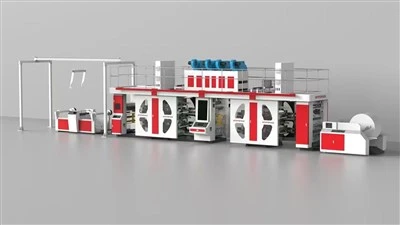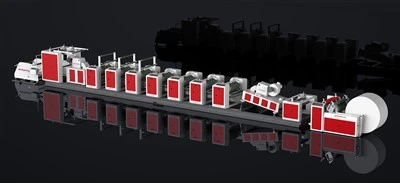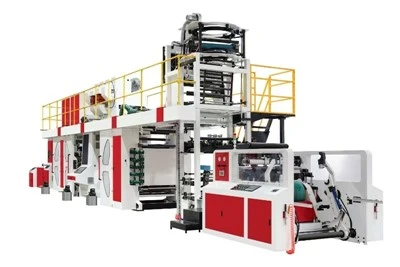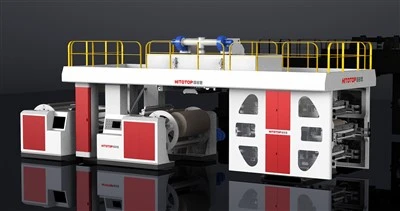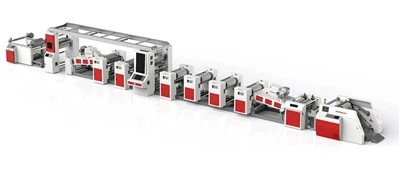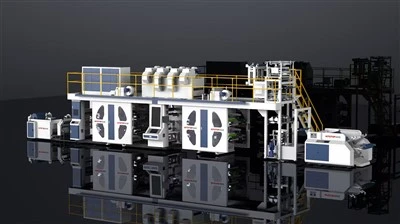

Layered Flexographic Printing Press (also known as a stacking flexographic printing press): Printing units are independently stacked one on top of the other, installed at one or both ends of the main printing press wall, and printing is achieved through gear transmission.
Basic Parameters: Supports 1-8 color printing, with 6 colors being the most common configuration.
Core Advantages: Enables double-sided printing; wide range of printable materials, compatible with rigid materials such as sheet paper and corrugated cardboard, and flexible materials such as roll-to-roll self-adhesive paper; flexible configuration of printing units, allowing for easy addition of post-press processing equipment such as varnishing and die-cutting; many stations are suitable for short-run printing; high degree of parts standardization; generally equipped with automatic control systems for tension and registration.
Applicable Scenarios: Suitable for trademarks and packaging boxes with medium printing precision requirements, as well as special printed products with small batches and urgent delivery deadlines. Satellite flexographic printing presses, also known as central impression (CI) flexographic printing presses, arrange all printing units around a large-diameter shared central impression cylinder. The substrate is printed around the outside of the central impression cylinder to complete multi-color registration.
Core advantages: High-precision registration is achieved through direct gear drive, eliminating the need for a complex control system. The printing process is stable, and the structure is rigid. Modern models are generally equipped with pneumatically operated, quick-load-and-unload sleeve-type printing plates/anilox rollers and gearless direct drive technology, allowing for plate changes in just one minute, significantly reducing changeover time. Most models feature a closed-loop dual-scalpel inking system, reducing solvent evaporation and foaming issues, and supporting high-speed production.
Applicable scenarios: Primarily used for printing color flexible packaging products. It maintains stable registration even on highly elastic materials such as plastic films, making it a mainstream choice for color packaging printing.